
by Shion, DFP Intern
In this article, you will learn about the background, initiatives, challenges faced, and results achieved by Saskia Shutt, a jewelry designer and craftsperson who practices responsible sourcing based on her unique values and convictions. Diamonds for Peace (DFP) hopes Saskia’s responses to our interview questions will inspire the readers on their pathway to responsible sourcing.
Who is Saskia Shutt?
Based in Brussels, Belgium, bespoke jewelry artisan Saskia Shutt creates 100% handcrafted pieces using only responsibly sourced precious metals and gemstones. In 2016, she became one of a few in Belgium to register for Fairtrade Gold and is recognized as a pioneer in responsible sourcing. Currently, she supports artisanal and small-scale miners (ASM) as a member of the “Community for Ethical Jewelers”—an international network of ethical artisans/designers—and since 2018 as a licensed brand for “Fairmined,” which certifies gold from empowered responsible mining communities. Her holistic ethical vision extends beyond the origins of her materials to include the production environment and digital environmental considerations, and she continues to share her message with the world.
Why is responsible sourcing necessary?
The driving force behind my commitment to responsible sourcing is a strong belief in equity: the idea that everyone has the right to a decent life. While I had long been aware of the industry’s serious challenges—such as child labor, poverty, and mercury pollution—as an individual artisan, I once struggled with how I could make a difference. Taking the opportunity of a studio relocation in 2001, I began by improving my own working environment, switching from chemicals to natural materials and implementing thorough recycling of metal shavings and sludge. Furthermore, I discovered Fairtrade Gold in 2010 and registered with Fairtrade Belgium in 2016. I realized that even as an independent jeweler, by sourcing directly from small-scale miners, I could support their self-reliance and help transform the industrial structure. Can jewelry born from materials with dark origins, such as child labor and poverty, truly be called beautiful? The desire to provide jewelry with an honest brilliance, offered with pride, sustains my current activities.
What can be achieved specifically because you are an independent jeweler?
Shortly after I began my initiatives, I faced the difficulty of the support system for Fairtrade Gold in Belgium being discontinued. While searching for alternative methods, I expanded my perspective to international networks, which led to my participation in the “Community for Ethical Jewelers.” The advantage of being a small-scale business operator lies in the speed of decision-making and the ability to keep supply chains short. By leveraging this and sourcing directly from mining communities, I can produce jewelry that meets high ethical standards while managing costs. When I first started, some customers left due to price increases, but in their place, I built relationships of trust with a new clientele seeking jewelry with clear origins that supports mining communities. Currently, we face challenges such as the difficulty of securing suppliers due to Brexit and changes in tax systems; however, I strive to ensure transparency by maintaining continuous dialogue with suppliers to confirm that our values align.
What specific steps do you take to ensure transparency?
For diamonds, I only use those that are traceable through “Canadamark” (mined in Canada’s Northwest Territories with respect for the sustainability) or “Second Life Diamonds,” which repurpose jewelry provided by customers. Regarding colored gemstones, I carefully select partners who engage in “Mine to Market” transactions, sourcing directly from the mines. While many companies opt for large-scale mining for its stable supply, I support artisanal and small-scale miners. This is because small-scale mining is a vital industry that supports the livelihoods of hundreds of millions of people worldwide and has a very high level of contribution to local communities. If large-scale mining is a mass-production model prioritizing efficiency, small-scale mining is “slow mining” that takes the time to respect both people and the environment. I also believe it is my responsibility as a craftsperson to refuse the use of materials that destroy the environment, such as coral, and to propose alternatives instead.
What is needed to change social awareness?
In regions where awareness of responsible sourcing has not sufficiently permeated, political barriers often pose major challenges. For instance, the intervention of a government reluctant to redistribute profits was the reason a gold mine in Mongolia was unable to maintain its certification in the past. To overcome such situations, I believe it is necessary not only to rely on individual efforts but also to encourage a change in government mindsets through support from the international community and the United Nations. Additionally, in cases where social awareness is slow to develop despite the absence of political barriers, it is important to involve influential figures in the industry as partners—similar to the movement advocating for sustainability in the Japanese pearl industry—to jointly promote educational activities and lobbying.
To what extent should sustainability be pursued?
Our efforts toward sustainability are not limited to the selection of jewelry materials. We can reduce our environmental impact in every aspect of business operations, such as running a website powered by renewable energy or using packaging made from FSC-certified (Forest Stewardship Council) paper. For me, sustainability is a way of life. I believe that everyone, not just jewelers, should take responsibility for the invisible parts of their business, such as carbon emissions in the digital field. For example, switching to an eco-friendly web hosting service is a small but vital step that can be taken in just one hour.
What changes do you hope to see in the jewelry industry in the future?
I hope for a change in consciousness among everyone involved in the jewelry industry. This is because I believe that truly beautiful jewelry is born from the recognition that its story begins at the mine, not at the artisan’s bench. My message to companies hesitating to adopt these practices is simple: “Just do it.” It is fine to take it one step at a time. Taking that first small step—talking to suppliers and finding partners who share your values—is the key to opening the door to transparency and a responsible future for the entire industry.
Interviewer’s Reflection
What emerged from our dialogue with Saskia is that sustainability is not merely a “choice of materials,” but an expression of “integrity” that defines the very nature of a business. Her thorough ethical stance, which emphasizes both worker dignity and environmental sustainability, was deeply evident. Furthermore, her approach of not viewing the scale of an independent jeweler as a constraint, but rather utilizing her agility to connect directly with like-minded suppliers, offers significant insights to the many companies hesitating because they find responsible sourcing difficult. Saskia’s words, “Just do it,” seem to speak to the importance of not becoming paralyzed by the fear of change, but rather taking that first step and building a network of shared values. Infused with respect for everyone from the miners to the customers and the global environment, her jewelry represents the transparency and responsible future that the industry as a whole should strive for.
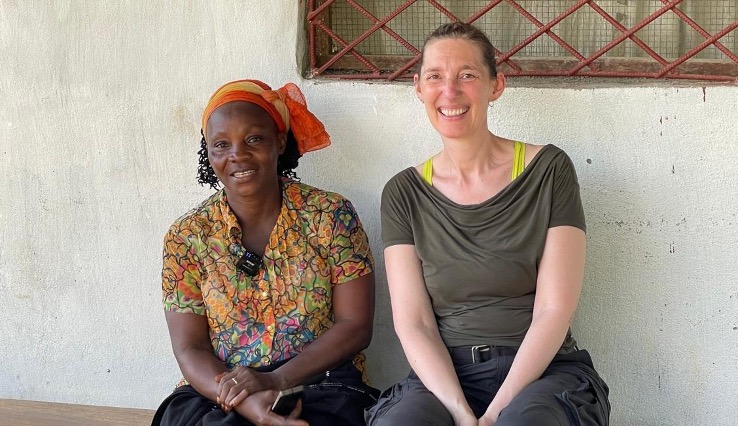
Front cover photo: A Liberian artisanal diamond miner Victoria and Saskia (taken by DFP in 2024)